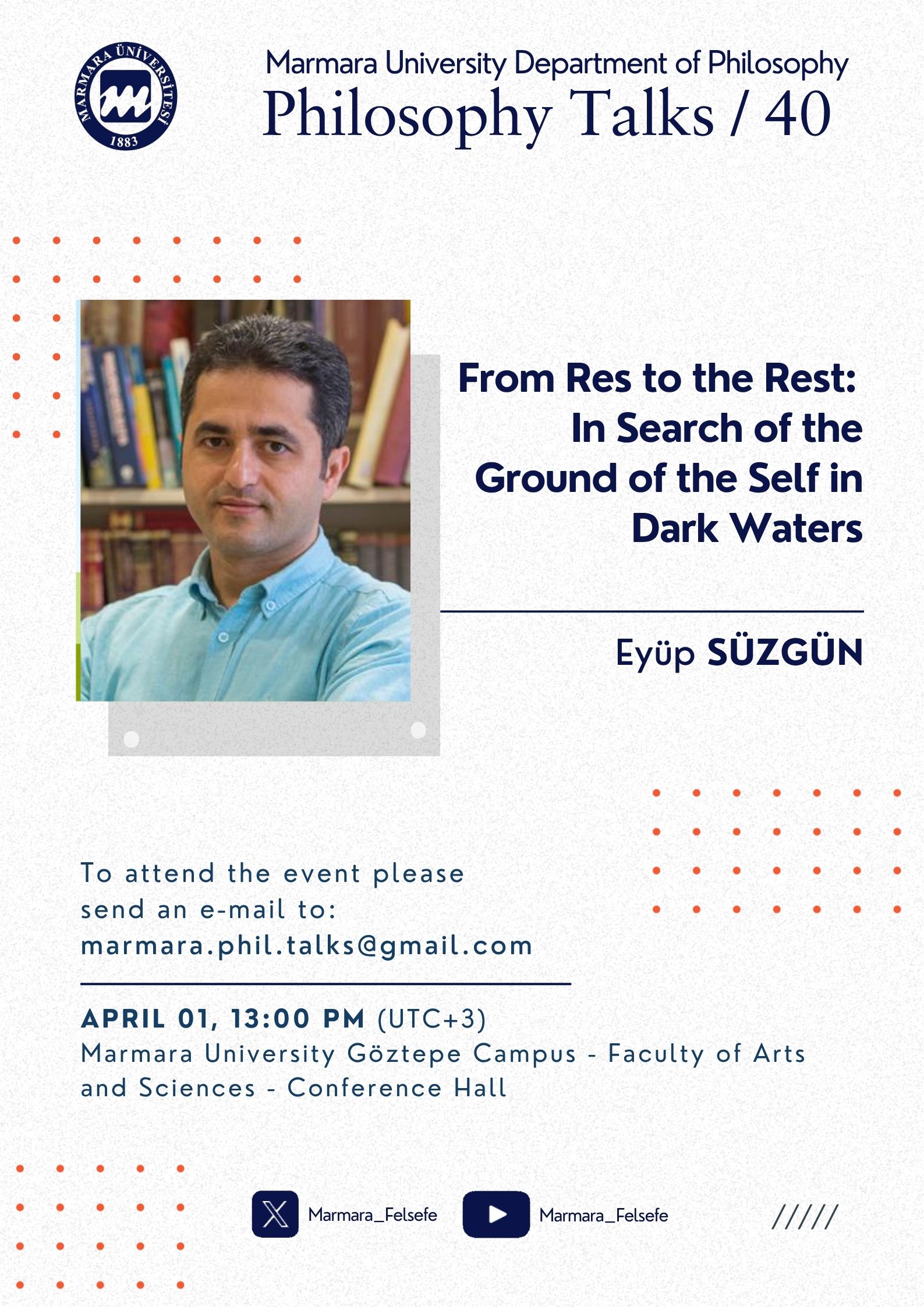
Abstract
In this talk, I revisit the problem of the self by tracing a conceptual shift from its classical ontological grounding as res—a substance or thing—to its modern reconstruction as an object of knowledge. I argue that this epistemic turn introduces enduring ambiguities concerning its status, unity, and locus, displacing the question of what the self is into the question of how, and to what extent, it can be known.
I suggest that these ambiguities persist in contemporary approaches, particularly in two dominant research strategies: those that explain the self in terms of the brain’s neural architecture and cognitive-functional organization, and those that locate or search for it within brain’s intrinsic activity. By interrogating the shared assumption that the self can be identified within such cognitive or neural frameworks, I examine whether these approaches genuinely advance our understanding of the self or instead reproduce earlier conceptual commitments in a new empirical vocabulary.
By situating these approaches within their broader conceptual lineage, I argue that the search for the ground of the self’s existence—whether framed in terms of substance, function, structure, or intrinsic neural activity—consistently invokes a domain that remains fundamentally “dark.” What appears to change across philosophical and scientific frameworks is not this underlying condition, but the way in which it is conceptualized and investigated. The ground of the self thus persists as an unknowable, irreducible, or not fully accessible “dark” basis, marking a structural continuity across philosophical and scientific accounts.


